
Last Updated on November 15, 2025 by Sarah Wilson
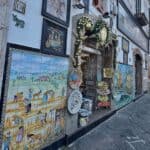
If you love street art, you will really love the amazing frescos in Beziers. For a fun way to explore the town, pick up a map at the tourist office or download this one here and let yourself be guided through the city’s historic centre by the many trompe-l’oeil frescoes of Béziers.
The colourful wall art brings local history to life, depicting significant events and well-known figures from Beziers’s past.
Most murals are in the city centre, but a couple are on the outskirts. The Béziers Tourist Office map shows 19 trompe-l’oeil wall frescoes. However, I found 20. Maybe I can’t count properly, or one is not listed, or it’s just random street art? 🤔
What is Trompe-L’Oeil?
The term “trompe l’oeil,” cleverly coined by the French artist Louis-Léopold Boilly, essentially means “to trick the eye.” It’s an incredible artistic technique where the artist skillfully uses lifelike imagery to create an optical illusion, making a flat surface appear more than meets the eye.
When walking the Frescos trail, I walked past some of the murals because they looked so real that I hadn’t realised they were paintings.
Fresco 1: Jean Moulin

Jean Moulin, a national hero of the French Resistance, was born in Béziers in 1899. The shop depicted in the fresco is his art gallery in Nice, which opened in 1942.
His activity as an art dealer allowed him to circulate, with a painting wrapped under his arm, between the Free and Occupied Zones to accomplish his mission in the Resistance.
Location: Place Lavabre
Fresco 2: The Paths of Compostela

I was very excited to find this one as it reminded me of happier times when Jonathan and I walked the Camino from St Jean Pied de Port to Santiago di Compostela in 2016. It’s time to plan another Camino, but I digress.
The Camino Romieu begins in Arles and passes through Beziers before joining the popular Camino Frances in Punta La Reina.
Location: 3 Rue St Jacques / Place des Casernes
Fresco 3: The Winegrowers’ Revolt of 1907

In the early 1900s, things took a turn for the worse for the wine industry in the South of France. It was a real crisis, with poor wine sales, overproduction, fraudulent practices, and even the sneaky introduction of artificial wines. To make matters worse, a flood of foreign wines was being imported, and workers’ wages were being slashed.
As you can imagine, the winegrowers weren’t too pleased with this situation. They had had enough and decided to take matters into their own hands. Together, they organised countless demonstrations that flooded the streets of Narbonne, demanding change. Leading the revolt was Marcelin Albert, a coffee shop owner and winegrower from Argeliers.
Their voices were finally heard, and in 1907 a law was passed to address the issues at hand. This law aimed to bring some order to the chaos by controlling the harvest, regulating wine circulation, and limiting sugaring. It was a small victory for the winegrowers, who had felt abandoned and overlooked for far too long.
So, amidst all the turmoil and strikes, this revolt marked a turning point in the wine industry’s history, paving the way for better regulation and, hopefully, a brighter future.
Location: 30 Rue St Jacques
Fresco 4: Moliere

Molière, born Jean-Baptiste Poquelin (1622 – 17 February 1673), was a renowned French performer, filmmaker, and author. He adopted the stage name Molière during his career.
His work Le Dépit amoureux (The Amorous Quarrel), was performed in Béziers in 1656.
Lovers’ Quarrels is a comedy in five acts filled with deception and misunderstandings. Ascagne, a young woman who has disguised herself as a man, loves Valère, who is pursuing her sister Lucile. In a clever manoeuvre, Ascagne tricks Valère into marrying her in a secret ceremony, with Valère believing he is marrying Lucile.
The play follows the ensuing quarrels between the characters, humorous conflicts, and reconciliations between their respective servants.
Location: 9 Avenue Alphonse Mas
Fresco 5: Sculptor Jean-Antoine Injalbert

Jean-Antoine Injalbert, a French sculptor born in Béziers in 1845, created many acclaimed sculptures. You can find a significant collection of his works at the “Hôtel Fayet,” one of the three “Musée Des Beaux-Arts” in Béziers. His old family home and summer studio, known as the “Villa Antonine,” also showcases some of his sculptures.
Location: Place des Bons Amis, at the entrance to Rue Viennet
Fresco 6: Jean-Marie Cordier, Famous Hydraulic Engineer

Jean-Marie Cordier designed a device to bring the Orb’s water up to the town to supply the fountains.
This was one fresco I didn’t realise was a fresco. I thought the two men on the right were just putting up a poster, but they are part of the mural.
Location: 5 Avenue Clemenceau/ Place de la Victoire – just behind the theatre.
Fresco 7: The Nine Locks of Fonseranes

The nine locks, also known as the Fonserannes Locks, were completed in 1680. They were built over two years, from 1678 to 1680. The locks located on the Canal du Midi were completed shortly after the death of Pierre-Paul Riquet, the engineer responsible for the canal’s construction and whose picture is at the top of the mural.
The locks span a length of 312 meters and have a total elevation difference of 21.5 meters between the top of the locks (in front of Le Coche d’Eau-Site Centre) and the water level of the Orb River, where the Canal du Midi initially connected.
The purpose of the locks is to enable boats to navigate through changes in elevation along the canal. With the nine locks, the water level can be adjusted to allow boats to pass smoothly through the canal despite variations in terrain.
Location: 17 Avenue du Colonel d’Ornano

Bonus fresco: Turn around, and you’ll see another fresco, but this one is not on the map. Who are these people in the painting?
Fresco 8: Commedia dell’Arte

The Commedia dell’Arte fresco is located on the rear wall of the theatre. Even though I passed by almost daily, I had no idea it was a fresco. It looks obvious now; maybe it’s time to get my eyes checked. The flag is real, as is the bit of fountain to the left of the frame.
Location: Rear Facade of the Municipal Theatre
Fresco 9: Camille Saint Saëns & The Opera Déjanire

Déjanire is an opera composed by Camille Saint-Saëns, which premiered in 1898. It is based on the Greek mythological character Hercules and draws inspiration from earlier works by Saint-Saëns. The opera’s first performance took place in Béziers, France, with the composer conducting.
While admiring this fresco, an elderly French man appeared and told me how Camille and his great-grandfather were best friends and how he had fond memories of growing up surrounded by music and song. It was fascinating listening to his stories.
Location: Place Saint Esprit
Fresco 10: L’Arlésienne by Alphonse Daudet

This mural depicts Marie Caufoppe, known as ‘the woman from Arles,’ standing on a balcony where her childhood home once stood. Accompanying her in the painting are three men: Bizet, Daudet, and Mistral, from left to right.
The fresco is inspired by a tragic tale involving L’Arlésienne’s unfaithfulness, which led to the nephew of the French writer Frédéric Mistral taking his own life. Alphonse Daudet incorporated her character into his novel ‘Lettres de mon Moulin,’ while Georges Bizet composed a musical piece based on this story.
Location: Boïeldieu Street
Fresco 11: Jean-Jacques Dortous de Mairan, Mathematician and Naturalist

Jean-Jacques d’Ortous de Mairan was a French scientist born in Béziers on November 26, 1678. Despite losing his parents at a young age, he achieved great success in various fields, including physics, ancient texts, and astronomy.
He made significant contributions to the study of biological circadian rhythms, and his work on heat theory, meteorology, and the motion of the moon was highly influential. He passed away in Paris on 20 February 1771 at the age of 92. In recognition of his contributions, a crater on the moon was named after him.
Location: 18 Rue Mairan
Fresco 12: The Coopers

Craftsmen who make wooden barrels for winemaking are called coopers.
Location : Rue Tiquetonne, corner of Rue des Balances
Fresco 13: The Rugbymen of Beziers

This fresco is a little bit of a walk from the city centre, but it’s on the way to Fresco 19.
Across from Duguesclin University, on rue Noël Sylvestre, you’ll find a sporty mural celebrating ASB-H, the Béziers rugby club. Established in 1911 and crowned champions of France 11 times, the team currently competes in the second division.
Location: Follow Avenue Georges-Clémenceau, then Avenue Jean-Moulin until you reach the media library.
Fresco 14: Casimir Péret, Mayor of Beziers in 1848

Casimir Péret, born in Béziers in 1801, lived during a time of political upheaval in France. He became the Mayor of Béziers during the Second Republic in 1848 when Louis-Napoléon Bonaparte was elected President. However, Louis-Napoléon later staged a coup d’état in 1851 to extend his power.
Casimir Péret led a rebellion against the coup but was ultimately captured and sentenced to jail. He attempted to escape but died in Cayenne in 1855.
The artwork depicting Casimir Péret in Cayenne shows the harsh conditions of the prison, with a convict’s uniform, barred windows, and a prison entrance. Casimir Péret is shown looking out of a window, wearing the sash of the elected Mayor.
Location: Place Louis-Germain
Fresco 15: Honoré d’Estienne d’Orves, Aviator and Resistance Fighter

Honoré d’Estienne d’Orves (1901-1941) was a French naval officer who played a significant role in the Resistance during World War II. He joined the secret services of Free France in London in June 1940 and created the first underground network called “Nimrod.”
He established the first radio connection between occupied France and London during a mission to France. Unfortunately, along with other network members, he was betrayed and arrested on 22 June 1941.
He was executed on 29 August 1941 at Mont Valérien. Before his death, he requested not to be blindfolded or tied, allowing him to embrace the officer in charge of the execution.
The quotation from the fresco is taken from the letter sent to his sister the day before his execution.
Location: 21 Avenue Alphonse-Mas
Fresco 16: First Train Arriving in Beziers

The arrival of the first train at Béziers station, then called “Gare du Midi”, in 1857. This fresco almost looks like a photograph, don’t you think?
Location: Rue Alfred de Vigny
Fresco 17: Viscount of Beziers, Raimon Trencavel

Raymond I Trencavel, who passed away in 1167, was a ruler in southern France. He inherited the viscounties of Carcassonne, Albi, and Razès after his brother’s death in 1150. Raymond formed a treaty with the Count of Barcelona, becoming his vassal.
His relationship with the Count of Toulouse was complicated: he joined him on the Second Crusade but later was imprisoned by his son. Raymond took part in Henry II of England’s campaign against Toulouse. He faced opposition from the locals and was assassinated in Béziers in 1167. His son Roger II succeeded him.
Location : 15/17 Rue de la Citadelle
Fresco 18: Antoine, Jean Moulin’s Father

Antoine Emile Moulin (1857 – 1938), the father of the renowned resistance fighter Jean Moulin, was a teacher at the large college of Béziers, specialising in history and geography. He was actively involved in the radical party and served as the deputy mayor of Béziers under Alphonse Mas (1894 – 1902).
He joined the Biterroise section of the League of Human Rights and eventually became its president. In 1913, he was elected as a general councillor of Hérault and was vice president of the departmental assembly.
Location: Place Antonin-Moulin
Fresco 19: View of the Cathedral

I have this very photo. It’s taken from the grounds of the Église Saint-Jacques in Beziers. This fresco is about a 30-minute walk from the centre of town. If, like me, you make it a mission to see all the murals but don’t fancy walking, you can take the B bus, which will drop you off almost outside.

Location: Place des Provinces
Beziers is an absolute gem of a city to stay in – one of those oooh; I could live here places. Check this post for more tips on what to see and do around Beziers.
Living in Malta, where they favour concrete over nature, it would be so lovely to break up the concrete grey with some remarkable street frescos.
How To Get To Beziers
By Air
Beziers can be accessed by plane through Ryanair, a low-cost airline offering direct flights from multiple UK airports, Paris Beauvais, Brussels, Düsseldorf, and Stockholm.
Beziers Airport is conveniently located only 13 kilometres from the city, and a shuttle bus service is available to transport you to the town. Other nearby airports include Carcassonne, Montpellier, Toulouse, and Marseille.
By Train
Another option is to travel to Beziers by train. TGV (high-speed trains) connections are available from Paris, Lyon, and Bordeaux, and there are also local trains that run to Carcassonne, Montpellier, Narbonne, and Sete. Train bookings can be made in advance through SNCF, or for convenience, I prefer using OMIO as it’s easier for me to understand.
By Car
If you plan to stay within Beziers, getting around on foot or by Le Petit Train is easy, so renting a car is unnecessary.
Where to Stay in Beziers
Beziers offers a wide range of accommodation options to suit various budgets. Check here for inspiration on where to stay in Beziers.
I was house-sitting for my stay in Beziers as it allowed me to indulge in pet cuddles while travelling and experience life like a local. I find my house-sitting opportunities through Trusted Housesitters. If you’re interested in joining, you can use this link to receive a 25% discount on your membership.
For More Posts On France, Check These Out
- Cruising the Canal du Midi
- Beautiful Mont Saint Michel Photos
- A Feast of Oysters in Cancale, France
- Things to do in Lyon
- A Day Trip to Giverny from Paris
- Explore Paris Like A Local With Paris Greeters
- Visiting The Paris Catacombs
- Pere La Chaise Cemetery
- A Secret Food Tour In Paris
- Bayonne
- An Afternoon in Angouleme
- Day Trips Around The Loire Valley By Train
- Best Things To Do In Beziers
- A Luxury Barge Cruise On The Burgundy Canal
- Best Things To Do In Bordeaux
- Saint Emilion: Day Trip From Bordeaux or Stay Overnight?
- One Day in Narbonne
- Day Trip To Sete
- Day Trip To Montpellier By Train
Save This Post For Later

Pin Post For Frescos in Beziers.
Disclaimer: Some of the links on this website are “affiliate links”, meaning that if you click on the link and make a purchase, I will receive a small commission at no extra cost. This helps me to keep my website running and continue to share my travelling knowledge with you. I thank you for using the links on my website.


I’ve never heard of these trompe l’oeil. amazing!